
What is joint ownership, and why does it block so much property in the French Caribbean?
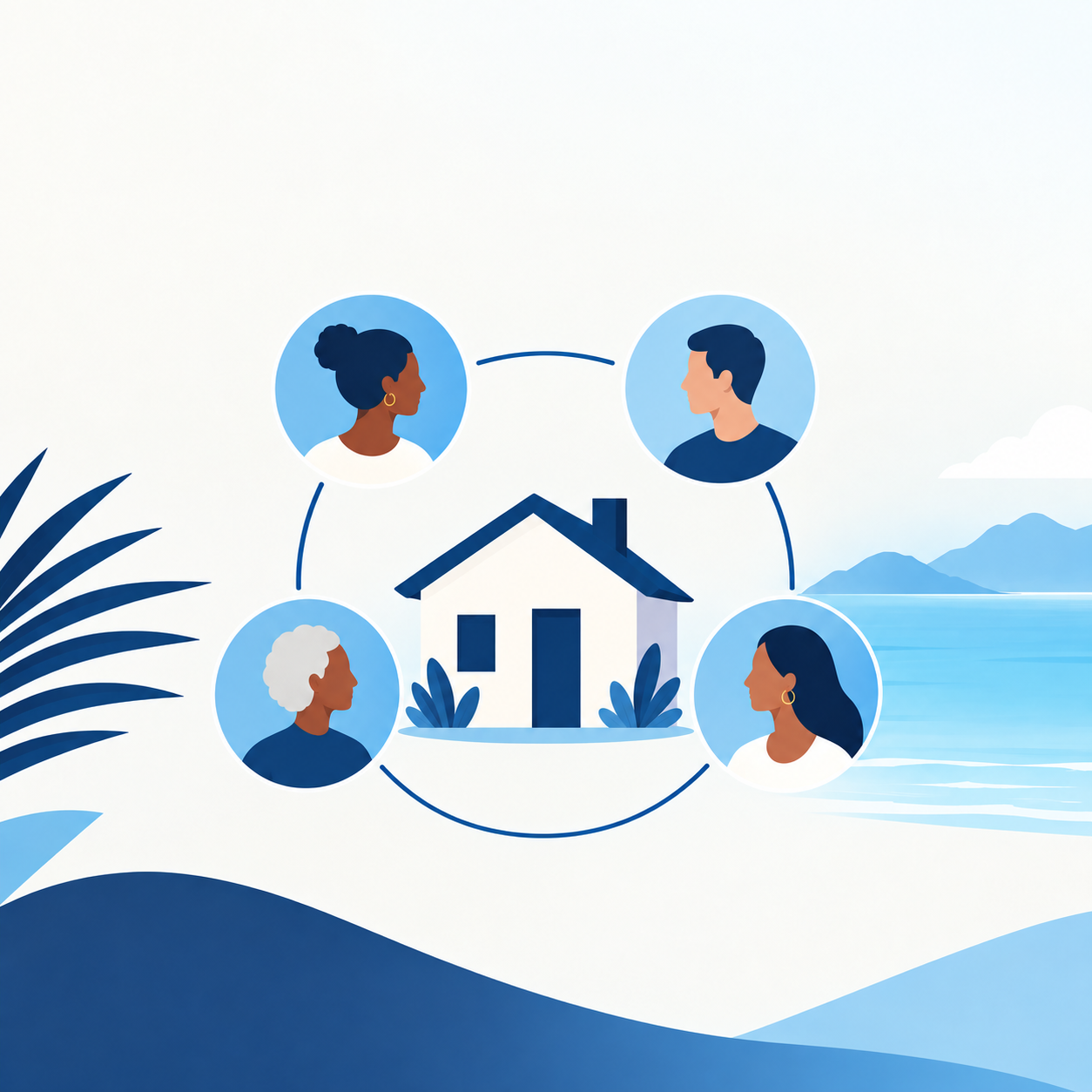
When a person dies leaving several heirs, their property is not automatically divided among them. Until the estate is settled, the house, land or apartment belongs to all heirs at once, with none of them being the sole owner. This is called "indivision" — joint ownership — a concept explained in detail on the official service-public.fr website (in French).
This period is meant to be temporary, pending the division of the estate. But in the French Caribbean, it sometimes lasts 20, 30, even 40 years, spanning several generations, as heirs themselves have children who in turn inherit their share. As a result, according to figures put forward by the Martinique Territorial Collectivity when its dedicated public body was created, between 40% and 50% of private land in Martinique is currently affected by joint ownership or a lack of clear property title, with a comparable share in Guadeloupe. This is one of the main causes of the abandoned houses seen in many towns across both islands.
Why it's so difficult to get out of joint ownership
The basic rule under French civil law is strict: to sell jointly-owned property or carry out major works, the agreement of all heirs is required, without exception. But as generations pass, the number of heirs grows, and it becomes harder to track them all down and get every signature — some live abroad, some are unreachable, others simply refuse to agree with the rest of the family.
Two measures have eased this deadlock: a law specific to the French Caribbean since 2018, and a brand-new national law from April 2026.
The measure specific to the French Caribbean since 2018 (the "Letchimy" law)
Given the scale of the problem in French overseas territories, law n° 2018-1244 of 27 December 2018, championed by Martinique MP Serge Letchimy, introduced a derogation reserved for Guadeloupe, Martinique, French Guiana, Réunion, Mayotte, as well as Saint-Martin, Saint-Barthélemy and Saint-Pierre-et-Miquelon (full details on the ANIL website, in French):
- For an estate opened more than 10 years ago, a majority of the joint ownership rights is enough to decide to sell or divide a property — unanimity is no longer required.
- The notaire (notary) can handle it directly, without going through a judge, considerably speeding up the process.
- An heir who has continuously occupied the jointly-owned home for more than 10 years can request priority allocation of it.
This measure currently applies to sale or division projects initiated before 31 December 2028.
An important caveat, documented in a technical report by Cerema: in practice, this law remains difficult to use in many cases, because a good number of the estates concerned are precisely not yet past the 10-year mark by the time heirs are looking for a solution. It is therefore not an automatic answer to every joint-ownership situation.
What the new national law of 7 April 2026 changes
Law n° 2026-248 of 7 April 2026, which came into force on 9 April 2026 (see the detailed explanation on service-public.gouv.fr, in French), further strengthens the framework at national level — meaning it also applies in the French Caribbean, on top of the Letchimy provisions already in place:
- Emergency sale by a single heir: a co-owner can now request judicial authorisation to sell jointly-owned property alone, if the sale is justified by urgency and by the family's shared interest (for example, to prevent a property from falling further into disrepair).
- Broader judicial division: court-ordered division proceedings can now apply to a wider range of situations, including between former spouses, civil partners or unmarried partners who have separated.
- Properties abandoned for more than 30 years: when an estate has been open for more than 30 years with no heir having come forward, the local municipality can now obtain the necessary information from the tax administration to begin a procedure to acquire the property, provided there is serious doubt about the owner's identity or whether they are still alive.
Note: this 2026 law also includes a specific regime for Corsica, unrelated to the Caribbean-specific provisions — the two should not be confused.
Who can help you, island by island
In Martinique: a dedicated public body, GIPI (the public interest group for resolving joint ownership and restoring property titles), created by prefectoral order in 2023, provides free support to families going through joint-ownership resolution and property title reconstitution, with possible financial assistance for the most modest families.
In Guadeloupe: as far as we know, there is no public body strictly equivalent to Martinique's GIPI. Handling blocked land there notably involves the EPFL Guadeloupe (local public land agency), which works mainly alongside municipalities rather than directly with individual families. For a family, the notaire remains the first point of contact.
In Saint-Martin: here too, with no dedicated body identified, the notaire remains the reference contact for starting the process.
The first practical step: get the property valued
Whichever route is taken — a majority-vote sale under the Letchimy law, an amicable or judicial division, or an emergency sale — one question always comes up: what is the property really worth? A proper valuation helps to:
- Give heirs a neutral, figures-based starting point for discussion, rather than relying on a rough estimate that often fuels tension;
- Support the sale price before the notaire or the court in the case of judicial division;
- Document the inheritance tax declaration filed with the tax authorities.
It's often the first concrete, no-obligation step a family can take to move forward, even before the heirs have agreed on what comes next.
Frequently asked questions
How long can joint ownership (indivision) last?
In theory, it's meant to be temporary. In practice, in the French Caribbean, some family joint-ownership situations last several decades due to a lack of agreement between heirs.
Do all heirs have to agree to sell jointly-owned property?
That's the general rule. But for estates opened more than 10 years ago in the French Caribbean, the Letchimy law allows a sale or division by majority of joint ownership rights, without unanimity. Since April 2026, a sale by a single heir is also possible with a judge's authorisation, in cases of urgency.
Does the Letchimy law apply to every joint-ownership situation?
No: it only applies to estates opened more than 10 years ago. Many more recent situations are not yet eligible.
Who can help me free of charge?
In Martinique, GIPI provides free support to families. In Guadeloupe and Saint-Martin, the notaire remains the first point of contact.
Should I have the property valued before starting the process?
It's not a legal prerequisite, but it is strongly recommended: a neutral valuation makes it easier for heirs to reach agreement and helps secure whatever comes next, whether an amicable or judicial division, or a sale.
This article provides general information for educational purposes, accurate as of its publication date, and does not constitute personalised legal advice. As every inheritance situation has its own particularities, we recommend consulting a notaire or a specialised lawyer before making any decision regarding your case.
Dealing with an estate, or a property in joint ownership?
Before taking any steps, a valuation gives you a solid basis to move forward with the rest of the heirs.